






Global GDP Growth & Fed Cuts: How Macroeconomics Are Shaping Forex Markets
The forex market is not just about technical charts and candlestick patterns — it is deeply tied to the health of the global economy and central bank decisions. As of October 2025, traders are watching two critical macroeconomic forces: stronger-than-expected global GDP growth and the growing likelihood of Federal Reserve rate cuts. Together, these trends are reshaping currency flows, risk sentiment, and volatility across the forex landscape.
The Global Growth Picture
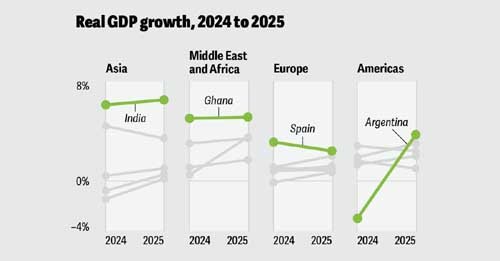
Despite ongoing geopolitical challenges and energy market uncertainties, global GDP growth has been surprisingly resilient in 2025. The International Monetary Fund (IMF) recently updated its forecast for global growth to 3.1% for Q3 2025, driven by steady demand in the U.S., moderate recovery in Europe, and robust expansion in emerging markets.
This stronger-than-expected performance has supported risk-on sentiment in forex markets, encouraging traders to move away from safe-haven currencies like the U.S. dollar, Japanese yen, and Swiss franc, and into higher-yielding, risk-sensitive currencies such as the Australian dollar (AUD), New Zealand dollar (NZD), and emerging market currencies.
The Fed’s Dovish Tilt
At the same time, the U.S. Federal Reserve has signaled a more dovish policy stance. After keeping rates elevated through the first half of 2025 to control inflation, the Fed is now preparing markets for a rate cut later this month.
Lower U.S. interest rates reduce returns on dollar-denominated assets, making the greenback less attractive to global investors. As a result, forex traders are pricing in further dollar weakness, particularly against currencies backed by improving economic data.
For example:
EUR/USD has strengthened as the dollar loses ground.
AUD/USD has seen renewed demand on the back of both global risk appetite and commodities strength.
USD/JPY is facing downward pressure as the yen regains safe-haven flows amid U.S. uncertainty.
Why Forex Traders Should Care
These macroeconomic shifts matter because they affect capital flows. When global growth is strong and the Fed cuts rates, investors tend to chase higher returns abroad, moving capital into riskier but higher-yielding assets and currencies.
This dynamic has the potential to create sharp moves in forex pairs, particularly those involving the U.S. dollar, commodity-linked currencies, and emerging markets. Traders who fail to account for these big-picture drivers risk being caught on the wrong side of major trends.
Key Forex Pairs to Watch
Here’s how some major pairs are being affected by the global growth–Fed cut narrative:
EUR/USD: Benefiting from dollar weakness, the pair is pushing toward multi-month highs. The euro’s gains could accelerate if eurozone GDP data surprises to the upside.
GBP/USD: The British pound is supported by stable domestic data, but Brexit-related uncertainty still weighs on long-term sentiment.
AUD/USD: A top beneficiary of global growth optimism, especially with strong demand for commodities like iron ore and energy.
USD/JPY: A more complicated pair — while dollar weakness pushes USD lower, risk-on sentiment can sometimes dampen demand for the yen.
USD/EM Currencies: Emerging market currencies like the Brazilian real (BRL) and South African rand (ZAR) are attracting flows but remain highly volatile.
Technical Backdrop
From a technical analysis standpoint, many USD pairs are showing bearish momentum:
DXY (U.S. Dollar Index): Currently trending lower, with support around 102.50 and resistance at 104.00.
EUR/USD: Testing resistance at 1.1900, with potential to move toward 1.2100 if the Fed cuts.
AUD/USD: Trading around 0.6900, eyeing 0.7100 on further risk appetite.
Technical traders should use macro events as catalysts, aligning breakout levels with central bank and GDP-driven narratives.
Risks to Watch
While the outlook appears favorable for non-dollar currencies, risks remain:
Global Growth Revisions: If growth slows unexpectedly in Q4, risk sentiment could quickly turn.
Energy Prices: A sharp spike in oil or gas prices could hit growth and support safe-haven flows into the dollar.
Geopolitical Tensions: Events in Asia, Europe, or the Middle East could disrupt risk appetite.
Fed Surprise: If the Fed delays or softens its rate cut stance, dollar weakness could reverse sharply.
Trading Strategies
Forex traders can position around these macro themes with strategies such as:
Trend following: Short the dollar against stronger currencies like the euro and Aussie.
Range trading: Use volatility around GDP data and Fed announcements to trade short-term ranges.
Hedging: Protect portfolios by diversifying exposure across safe-haven and risk-on currencies.
As always, stop-losses and risk management are essential, especially in an environment of heightened volatility.
Final Thoughts
The intersection of stronger global GDP growth and looming Fed rate cuts is a defining theme for forex markets in October 2025. The dollar is weakening, risk-sensitive currencies are gaining, and traders who align with the macro narrative are positioned to benefit.
While risks remain, particularly from energy markets and geopolitics, the near-term outlook favors a weaker dollar and stronger performance from risk-on currencies. For forex traders, this is a reminder that the biggest moves often come not from technical charts alone, but from the macroeconomic forces shaping the financial world.