







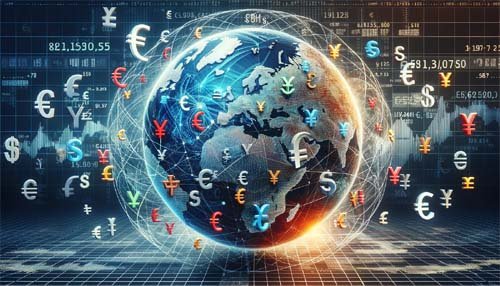
While headlines are dominated by stock markets, crypto volatility, and tech IPOs, one market operates silently in the background — the Forex market, the largest and most liquid financial market in the world, with over $7.5 trillion traded daily. Yet, it’s rarely in the spotlight.
Why? Because Forex isn’t flashy — it’s foundational.
⚙️ Forex Is the Operating System of the Global Economy
Think of Forex as the “currency layer” of globalization.
Every time a multinational company imports raw materials, pays international staff, or reports earnings in a different currency, it interacts with the Forex market — either directly or through intermediaries like banks.
-
Apple needs to convert billions of yen to USD? Forex.
-
A traveler exchanges euros for Thai baht? Forex.
-
A hedge fund hedges its position on the eurozone’s inflation data? You guessed it — Forex.
It’s not just trading; it’s global functionality.
📉 It’s Not Just About Charts — It’s About Nations
Forex is unique because it’s the only financial market where the players include entire countries.
-
Central banks intervene to stabilize inflation or boost exports.
-
Governments manage foreign reserves to influence trade.
-
Geopolitical tensions instantly ripple through currency pairs like USD/JPY or EUR/USD.
When the Swiss National Bank unpegged the franc in 2015, it sent shockwaves across global markets. When the Bank of Japan intervenes in the yen, every Forex trader watches.
In this game, you’re not just trading numbers — you’re trading economic confidence.
📊 Why Traders Are Drawn to Forex
Forex offers something most markets don’t:
-
24/5 trading — it never sleeps, rotating through major hubs like London, New York, and Tokyo.
-
Massive liquidity — tight spreads and deep order books mean efficiency.
-
Leverage — which is both a blessing and a curse.
Unlike stock trading, Forex doesn’t require you to buy an asset outright. You’re speculating on the relative strength of one economy versus another.
And it’s not just retail traders — banks, hedge funds, and multinational firms all play this game.
🤖 The Rise of Algorithmic and AI-Driven Forex
Forex is increasingly becoming a machine’s market.
-
High-frequency trading (HFT) firms execute trades in milliseconds.
-
AI models predict short-term currency moves based on real-time macro data.
-
Even retail platforms now offer algorithmic trading via bots and custom strategies.
The modern Forex market is part finance, part data science, and part game theory.
🔐 The Future of Forex? Decentralized and Tokenized
As crypto and traditional finance begin to merge, Forex may evolve beyond centralized institutions.
-
Tokenized fiat currencies (like USDC, EURC, or JPM Coin) could offer real-time Forex settlements on blockchain.
-
Smart contracts may automate FX hedging in international business.
-
Decentralized Forex (DeFi FX) protocols are already emerging, offering permissionless currency swaps.
This could eventually lead to a world where cross-border money movement is as simple as sending an email — with Forex trading operating in the background as invisible plumbing.
🧭 Bottom Line
Forex isn’t just for traders or bankers — it’s the invisible infrastructure of the modern world economy. Every flight abroad, every Amazon shipment, every international contract — it all runs on the quiet power of Forex.
While it may lack the spotlight, Forex is the bloodstream of global commerce — and it’s evolving faster than most people realize.